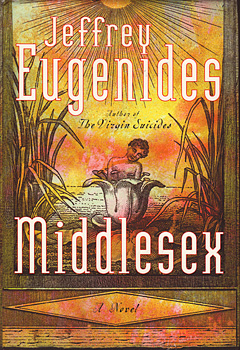
The book was like no other; it was extraordinary though. The way it was written allows the feelings of every character to been seen. It made me grow to love the large Stephanides family and feel for each individual. At the end of the book a tragedy strikes the family; Milton dies in a car crash. The last hours of his life were spent trying to find his lost daughter, Callie. “All his life he had lectured everybody about the right way to do things and now he had done this, the stupidest thing ever. He could hardly believe he head loused things up quite so badly. His last word, therefore, was spoken softly, without anger or fear, only with bewilderment and a measure of bravery. “Birdbrain,” Milton said, to himself, in his last Cadillac. And then the water claimed him.” (P. 511) His death brought sadness to the family that would forever sting their hearts. Though Milton’s death was terrible, the description about how he felt in his last seconds made me appreciate all that he went through. Instead of being torn up, like I thought I would be if another death happened, I accepted the loss of Milton. He was a wonderful, caring father that never changed even in his final moments.
Cal returned home and was introduced back into the life he once knew. Desdemona had begun suffering from memory loss while he was missing. She couldn’t remember who many people were, especially not Cal since he had formerly been known as Callie. When Desdemona first saw him she thought it was Lefty coming back to take her to heaven. The hardships that this family has been through is unbelievable. My emotions were all across the board while reading this book. Sometimes jubilation overtook me, while other times tears rolled down my cheeks. The book was so craftily compiled that I would easily enjoy rereading it all over again. I would also recommend it to anyone. Though it is a book about a hermaphrodite, it is definitely not what I thought it would be like. The book tells the story of a family, unlike my own in many ways, but nevertheless, a loving family. The book ends with hope. Having overcome multiple challenges Cal is still optimistic. “‘I like my life,’ I told her. ‘I’m going to have a good life’” (P. 528). It was this quote that put a perfect ending to an exquisite book.
Thursday, December 10, 2009
An end and a beginning
Wednesday, December 9, 2009
Character Study
Callie Helen Stephanides (
“Like most hermaphrodites but by no means all, I can’t have children. That’s one of the reasons why I've never married. It’s one of the reasons, aside from shame, why I decided to join the Foreign Service.” (P. 106)
Callie Stephanides grew up as a normal girl. She was dressed in dresses and appeared to be just like any other girl. “The beauty I possessed as a baby only increased as I grew into a girl” (P. 278). Everyone around watched Callie grow from this beautiful infant into an awkward adolescent teenager. She began to feel left out and worried when her body was not following the trends of the other girls in her grade. When her brother was becoming more of a stranger to the family, Callie was still as close as ever with them. She helped care for her grandmother and family dinners were always a part of her life. While still in her female body, we see her feelings towards certain girls. The feelings are described as indescribable. Throughout the book we also see snippets of
Desdemona Stephanides
“The truth was that in those days Desdemona was struggling against assimilationist pressures she couldn’t resist. Though she had lived in
The book starts out with the beginnings of Desdemona and her brother’s lives. Escaping their country they came over to
Eleutherios Stephanides (Lefty)
“Roulette wheels spun behind Lefty’s eyes as he sped toward the
Lefty is the one who first confesses his feelings for his sister. He is the one that makes the decision to go to
Miltiades Stephanides (
“We watched
Theodora Stephanides (Tessie)
“Theodora’s physical appeal was more obvious. She had inherited Sourmelina’s beauty on a smaller scale. She was only five foot one, thin-waisted and small-busted, with a long, swanlike neck supporting her pretty, heart-shaped face.” (P. 174)
The mother of the narrator, Tessie was always gentle and dainty. After realizing the mistake she made of not being with
Tuesday, December 8, 2009
Personal Response
After reading a good two thirds of the book I decided to write about what I think so far on the style of his writing, the characters, and the overall content of the book.
The style of how Eugenides writes is very easy to read. Before I know it I’m fifty pages from where I started. The setting is described very thoroughly and allows me to picture how they are living. “But more important to a kid: Middlesex had lots of sneaker-sized ledges to walk along. It had deep, concrete window wells perfect for making into forts. It had sun decks for catwalks.” (P. 261) Not only is it easy to read, but it also perfectly matches the age of the narrator in each scene. When he is a small child we see what confuses him and what he doesn’t understand. As he grows older his narrating matures too. Every page is full of dialogue and descriptions that make it all the more interesting. I have not come across a passage that drags on too long or looses me midway through. This book truly has me captivated until the very end.
As for the characters, they are very believable. Eugenides started with the narrator introducing himself then jumped back a couple of decades to be able to fully describe every character. The descriptions and stories only add to the complexity of each character making them seem much more humanlike and interesting. We follow the lives of his ancestors up until they have kids, then we switch and follow the kids lives and so on and so forth. This is the first book I have read where I have gotten full life stories of the characters in order to fully understand them. I have found myself becoming very attached to some of the characters. I’ll even admit to shedding a few tears when the first death interrupts the happiness of their lives. The way Eugenides writes the book made me connect to the characters on many levels making it all the more enjoyable.
Then there is the content of the book. Before, I have never even really thought about hermaphrodites, let alone their lives and how they live and grow. When thinking of unusual relationships, gay marriage is the first thing that comes to my mind. Now reading this book I realize that there are other people who struggle in the dating world because of their sex or partiality. The book gives somewhat scientific references.
“To the extent that fetal hormones affect brain chemistry and histology, I've got a male brain. But I was raised as a girl. If you were going to devise an experiment to measure the relative influences of nature versus nurture, you couldn’t come up with anything better than my life. During my time at the Clinic nearly three decades ago, Dr. Luce ran me through a barrage of tests. I was given the Benton Visual Retention Test and the Bender Visual-Motor Gestalt Test.” (P. 19)
I find it interesting to look at the life of someone very much unlike myself. I am looking forward to the end of the book to understand just how everything works out for
Image Study

The characters in the book share a common thing, their background. Desdemona, Lefty, and Sourmelina all came from a small Greek town. In

One of the ways

What started at a young age, continued into adulthood for

Making your way in
(sources cited at bottom of page)
Monday, December 7, 2009
Themes from American Literature
Love always wins
Throughout the book readers see that a major part is the many characters falling in love. From the beginning we have the two siblings, Desdemona and Lefty, start it all off. Living together they try and suppress feelings of longing towards one another. After each failing to find significant others, they let their true feelings show. We see how Desdemona is conflicted in accepting the fact that she loves her brother. When they are in a pressured situation Desdemona agrees to Lefty’s proposal that if they make it to American she will marry him. On their journey to America they do end up getting married. But in order to get married they first devised a plan that allowed others to think they were meeting for the first time. This plan worked, of course, but it was made so that they would also believe they were strangers. Upon coming to America they made a promise never to tell anyone for they knew that what they had done would not be easily accepted. Eventually Desdemona and Lefty forgot all together about being siblings. The love they had for one another was so strong and only grew that much stronger; it seems as if they were meant for each other from the very beginning.
Desdemona and Lefty had a son together, Milton. He grew up in a house with his second cousin Tessie. As they grew older they started spending more alone time together. At first it was just hormones. But the more they spent time privately together, the more intimate things got disregarding their skeptical feelings. When Desdemona understood what was happening, she tried to set up Milton with a new girl. With each girl there was something wrong with her, she wasn’t Tessie. While Milton was having a new girl almost everyday, Desdemona also pushed a young man into liking Tessie. Desdemona was trying so hard to keep the two away from each other because she knew incest was wrong and didn’t want them making the same mistake she did. Tessie started dating this man and when they got engaged Milton went off to war to try and forget her. While Milton was away Tessie realized there was no one she loved more than him. Calling off her engagement, Tessie and Milton were soon married. The two justified their love saying it was acceptable because they were only second cousins. Despite their principles, they saw themselves as soul mates.
Accepting who you are
Each character goes through a visible stage of accepting his or her self. For the main character and narrator it is a little more obvious. Callie, as a young girl, must come to terms with how she is different. Growing up she had feelings she couldn’t explain about the same gender. Since she was so young she was able to pass them off as her just being naïve and foolish. As she gets older the girl’s bodies around her begin to change while she hangs frozen in motion between being a child and physically mature. She struggles in accepting her flat chest and mountainous height. Callie tried to fit in by buying a bra and eating foods which she thought would help her fill out. She was self conscious all through adolescence and never really grew out of it. When Callie was changed into Cal, he began to have new problems with accepting himself. Cal was never sure of himself and when it came to women he fled. The fact that he was different from everyone else made him nervous and scared of what others thought. Dating would go as far as the second or third date, but when it got serious he got out. The book shows Cal as trying to accept his body and himself but end before he attains total self-acceptance.
The other characters also try and accept who they are. Milton, Tessie, Desdemona and Lefty all have distinct and separate feelings on their incestuous behaviors. Each person has his or her own internal conflicts eventually being able to come to terms or suppress what they have done. Sourmelina is different from the family in that she is a lesbian. She was outcast from her town by her father and forced into marriage. Eventually as time passes and events happen she is able to marry a partner that she truly loves.
Chance rules
Our narrator specifically tells the details and events leading up to her birth. From the start she states how everything that happened had to occur just that way or he wouldn’t be alive. A significant event that was left up to chance was Milton in the war. He went to Navy camps and was in a troop where death didn’t occur very often. Right when he was switched to a new position where the death toll was very high he received an acceptance letter from the Naval Academy. His life was saved which allowed him to go back and marry Tessie. Another moment Cal says is significant in his life is his very birth. Minutes after he was born the doctor holding him was doing a routinely check making sure he was a healthy baby girl. As he was going to inspect her female private parts a nurse tapped him on the shoulder very flirtatiously. Thus, ending the inspection and having no one notice that she was no normal girl. One more matter that was left up to chance was Cal’s mutation on his chromosome. Both Desdemona and Lefty carried the mutation but neither passed it on to Milton or their other daughter. Tessie also carried the mutation, but not until Cal did it become present. It was only by chance that Cal was the one who received the dominate mutation.
Monday, November 23, 2009
Rhetoric Study
“I feel a little like that Chinese princess, whose discovery gave Desdemona her livelihood. Like her I unravel my story, and the longer the thread, the less there is left to tell. Retrace the filament and you go back to the cocoon’s beginning in a tiny knot, a first tentative loop. And following my story’s thread back to where I left off, I see the Jean Bart dock in Athens. I see my grandparents on land again, making preparations for another voyage. Passports are placed into hands, vaccinations administered to upper arms. Another ship materializes at the dock, the Giulia. A foghorn sounds.” Pg. 63
The passage above is a perfect example of literary devices Eugenides uses throughout the book. Here we see the unraveling thread being used as a metaphor for retelling the events of one’s life. Simple metaphors are used throughout the book to help readers connect their own lives with what is happening to the characters. It is an effective way to keep the interest of others and helps describe whatever the scene may be in easier terms. It is the author’s way of not complicating the plot with confusing or lengthy text.
We also see from this passage description of the scene. It happens to be a selection where the author is returning us to the main plot of the novel very quickly. Although it is short, choppy sentences that recap the details, not all of the book’s descriptions are like this. Throughout the book, the use of facts and details is almost always present. Giving small attention to detail really makes his story believable for the time period it is placed in. It allows readers to understand and follow the novel easier.
Although from this selection it is just one word, Eugenides uses Greek words often to give emphasis on the family heritage. He never explains what they mean, so you would think it could get a little confusing. But, in the way he words them in; usually I can decipher or automatically know what they mean. Though the setting mainly takes place in America, these Greek words are small reminders of where our story started out in the very beginning. Also the dialect of our characters when they talk reminds us that they immigrated here. A quote from Desdemona shows just how little English they know; “‘Yes. I am silk worker. Have lot experience. Farming the silk, making the cocoonery, weaving the…’” (Pg. 144)
Eugenides also has a distinctive syntax. His sentences are very simple and easy to read. Some books have a single sentence stretch on for over a page, well not this one. So far into the book I have not encountered a sentence that has outlasted my breath. The way he writes makes it easy to read and for that I’m thankful. Because there are no challenging sentences, I am enjoying being able to understand everything completely.
Sunday, November 22, 2009
Breaks from the past
The way the book is written is very unique. I can’t recall another book that starts in the present, is mainly told from the past, and yet has interruptions to connect with the text from any time period. At some points the book even sounds like a letter or some biography. For example:
“But that’s enough about me for now. I have to pick up where explosions interrupted me yesterday. After all, neither Cal nor Calliope could have come into existence without what happened next.” Pg. 42
The story is, for the most part, chronological. The quote above is just one instance where we see the timeline mix up for just a moment to describe something else. Other times it’s like the narrator stops the action completely to add a little of his own thoughts. Sometimes it even seems like he is talking to the readers directly. Again, another example:
“And while Lefty stops to breathe it in, I’d like to take this opportunity to resuscitate -for purely elegiac reasons and only for a paragraph- that city which disappeared, once and for all, in 1922.” Pg. 50
The unique style is just another way to further develop the characters. We see Desdemona as a normal housewife who cooks and cleans and takes care of the children, even Theodora who is not her own. Lefty who is a husband struggling to stay close with his wife while having to manage jobs and worry over money. As for Lina, her husband’s death didn’t seem to slow her down for too long, for in a matter of months she was back to her original self. It’s interesting knowing that even though the children are young now, the way the book is progressing lets us know that we will definitely see them as adults. We have already seen snippets of this from short parts that interrupt the normal pattern.